01
What changed this quarter?

Tenants occupied 357,584 more square feet of office space than they gave up across Ottawa-Gatineau in the third quarter of 2026. Vacancy stands at 7.0%. That is well above the market’s long-run average of 4.9%, but it remains below the national office vacancy rate. Sublease availability continued to shrink, a sign that some occupiers are taking back space they had previously put on the market.
The rest of the market, outside the buildings CoStar tracks individually, added a further 213,097 square feet in the quarter. Figures in brackets are space given back.
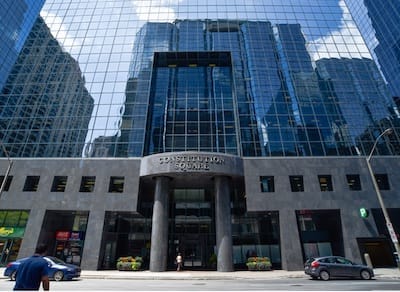
The biggest single gain came in Bells Corners, in the Kanata submarket, where 1935 Robertson Road leased up 43,967 square feet. Downtown, Constitution Square Towers II and III and the Fuller Building together added 64,839 square feet, and 179 Du Portage Promenade in Gatineau added 22,799. The largest give-back was at One60 in Centretown-ByWard, which returned 39,325 square feet.
02
Why does building age matter so much?

Ottawa now has two office markets living side by side. Buildings completed in 2010 or later report vacancy of 4.9%. Buildings completed before 2010 sit at 15.8%. Among non-government, non-owner-occupied buildings over 20,000 square feet, vacancy is 14.4%, rising to 21.2% when you look only at the buildings actively marketing space.
Building class alone does not explain the gap. Class A space still carries 13.3% vacancy, while Class B sits at 5.4% and Class C is nearly full at 1.3%. What tenants are rewarding is newer construction, efficient floor plates and strong ESG credentials, which is also what federal leasing standards require.
Tenants are using this gap to their advantage. Much of today’s leasing is churn: organizations relocating within the market, upgrading to better buildings and shrinking their footprint at the same time.
03
What are tenants really paying?

Average gross asking rents sit at $33.33 per square foot. Asking rent is only part of the story. Free rent periods and generous inducement packages remain common, and effective starting rents are estimated to be closer to $29.00 per square foot.
Quality still commands a premium. Class A space asks close to $38.00 and Class B about $32.00. Even at the top end, Ottawa remains affordable next to Toronto and Vancouver, where average asking rents are approximately $41.00 and $47.00 per square foot.
See the numbers
| Submarket | Asking rent ($/sq ft) | Vacancy |
|---|---|---|
| CBD | $38.29 | 9.9% |
| East Central | $34.97 | 9.5% |
| Centretown-ByWard | $33.55 | 6.6% |
| Tunney’s Pasture | $32.96 | 2.6% |
| Gatineau | $32.69 | 4.1% |
| West Central | $30.85 | 8.5% |
| Kanata | $30.10 | 9.1% |
Gross asking rents in Canadian dollars; vacancy as reported for the third quarter.
Expect rent growth to stay muted in the near term. The forecast calls for average asking rents of about $34.50 by the end of 2027, with stronger growth after that as limited supply and the steady removal of older buildings tighten the market.
04
What does the four-day mandate mean for demand?

The federal government has moved to a four-day in-office requirement, with senior management expected on site five days a week. At the same time, it plans to reduce its workforce by roughly 40,000 positions. Those two policies pull in opposite directions.
Some market participants believe departments shed too much older space during the remote-work years and may now struggle to fit returning staff within current allocations. That could mean a near-term lift in government leasing. Any new federal demand is expected to focus on newer, ESG-compliant buildings that meet its space standards.
Private-sector demand is helping to offset public-sector caution, supported by federal investment in artificial intelligence, defence, housing and infrastructure. The third quarter’s largest lease was a 48,947 square foot renewal at Performance Court in Centretown-ByWard. TechInsights renewed 38,011 square feet at 1891 Robertson Road in Kanata, Second Nature leased 21,895 square feet at 53 Auriga Drive, PCL Construction took 15,458 square feet at Qualicum Centre, and the Liberal Party of Canada leased 15,047 square feet at Constitution Square Tower II. BMO and Capital Crossing Construction each signed about 10,000 square feet at Churchill Office Park.
Ottawa’s talent base remains a steady draw for employers: nearly half of residents hold a bachelor’s degree or higher.
05
Where will new space come from?

Almost nowhere. Only 61,598 square feet is under construction across three buildings, just 0.1% of existing inventory, and 90.7% of it is already preleased:
- 1515 Earl Armstrong Road, 42,496 square feet by Urbandale Corporation, completing February 2027
- 4405-4409 Innes Road, 12,000 square feet for IDEAL Health Group, completing April 2027
- 3130 Woodroffe Avenue, 7,102 square feet, completing December 2026
Meanwhile, weak demand for older inventory continues to push obsolete buildings out of the market, many of them toward residential conversion.
Thin supply and continued conversions are the main reasons the outlook improves. Forecasts show market vacancy easing to about 6.4% by the end of 2027 and 5.6% by the end of 2028.
06
Who is buying, and at what price?

The third quarter’s largest sale shows how divided the investment market is. 70 Crémazie, a fully occupied 377,399 square foot Class A building in Gatineau completed in 2003, sold in August for $66.9 million, or $177 per square foot. A month earlier, the Silver Seven Corporate Centre at 747 Silver Seven Road, completed in 2021, traded for $14.7 million, or $685 per square foot, at a 7.3% cap rate.
Smaller deals filled out the quarter. 2505 St. Laurent Boulevard sold for $7.15 million ($287 per square foot), 2618 St. Joseph Boulevard for $3.83 million ($312) and 5 Blackburn Avenue for $3.75 million ($483). Buyers are paying a premium for newer, efficient space and pricing older buildings to reflect the work ahead of them.
For buyers looking at conversion, the math is tight. Repositioning projects are complex and capital-intensive, and often need acquisition prices below $100 per square foot to work.
07
What should you do with this?

Markets in transition reward organizations that move with a plan. Here is how we are advising clients this fall.
If you lease space
- 1
Start early
Begin renewal planning 18 to 24 months out. Newer buildings are tightening first.
- 2
Negotiate effective rent
Incentives remain meaningful. Compare deals on what you actually pay.
- 3
Use term as leverage
Longer commitments can buy a stronger allowance and flexibility rights.
If you own space
- 4
Know where you stand
Place your building honestly on the age and quality divide.
- 5
Plan before vacancy decides
Test upgrades, repositioning or conversion while you still have options.
Ottawa’s office market is not fully recovered, but the third quarter was a positive one, and the gap between the best and the rest is the clearest signal in the data. The right space is out there. The time to secure it is before everyone else comes looking.